
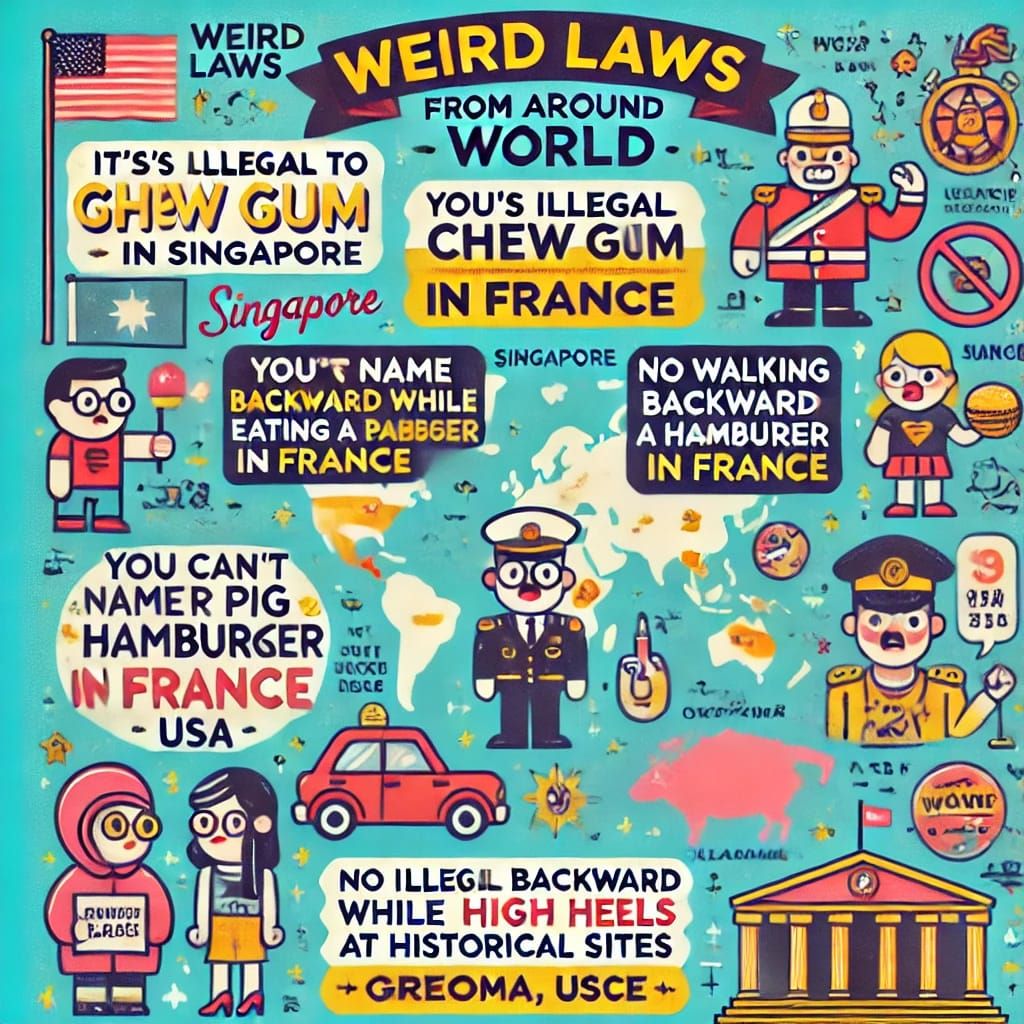
Weird Laws from Around the World
Every country is different, and every country’s laws are different from each other. There are lots of policies and laws that we should follow. But some places around the world have laws which might be so strange, it’s difficult to believe they’re actual or maybe necessary. As people travel to different places, they may have explored some of different laws at every location. From their unique values and exclusive cultures, every place follows poles apart set of laws. However, at times, a number of those laws are so weird and bizarre that you can’t help but wonder what provoked the lawmakers of that place and county to approve some of the laws. Here are some of the laws which are difficult to agree that they exist.
It's Illegal to Chew Gum in Singapore.
In 1992, chewing gums were banned in the country, however it is not illegal to chew them. In 2004, the ban had a change and considering that then it is possible to shop for therapeutic, dental, and nicotine chewing gum from a doctor or pharmacist. The ban was introduced due to the fact that people had started sticking chewing gum on the door sensors of trains, mailboxes, inside keyholes, on lift buttons, stairways and wherever it was difficult to clean.
It's Illegal to Feed Pigeons in Venice.
Feeding pigeons in Venice is illegal under the Italian law, that means you may be landed with a heavy fine. If you have ever fed pigeons before, be aware, because you may have to pay a heavy fine for doing so, this is in case you do it in St. Mark's Square, placed in the centre of Venice. City officers have banned the common practice of feeding the local pigeons that frequent the square, in a bid to prevent the flying rodents ruining their UNESCO popular city. The ban has been in effect since 2008, and offending that can land you to pay a fine for something up to £622 (€700).
No Selfies with Buddha in Sri Lanka.
When you are taking a selfie or a photo with Buddha, you are turning your back on him. This sign of disrespect is punishable through imprisonment in Sri Lanka. It is likewise taken into consideration disrespectful to point your finger at Buddha, and sometimes there are bans on taking photographs with the statues. 70% of Sri Lankans sense Buddha as a prophet and avatar of the god Vishnu.
Married Women Can Only Have One Glass of Wine in Bolivia.
Bolivian town of La Paz has a as an alternative unbalanced policy towards alcohol consumption. In restaurants, married women are not allowed to be served more than one glass of wine. The purpose for this policy reportedly is that it needs to prevent ladies from getting too drunk and flirting with other men. This sexist law is because of the perception that alcohol may also make a lady more immoral. A husband may want to genuinely divorce her if she is ingesting in public.
People have to Follow Baby-Naming Guidelines and Law in Denmark.
According to the country’s law, the final preference for a baby’s name should come from a pre-approved listing of 7,000 names. If they need to go along with something different, they need to get authorities approval. Denmark's very strict Law on Personal Names is in place to defend children from having unusual and uncommon names that match their mother and father' fancy. To do this, parents can select from a listing of only 7,000 pre-authorized names, a few for girls, a few for boys. If they need to name their child something that is not on the listing and still they want to name it, they need to get special permission from their nearby church, and the name is then reviewed via way of means of governmental officials. The law states that girls and boys should have names that indicate their gender, you cannot use a last name as a first name, and uncommon names can be rejected.
According to the law, Billboards are banned in Alaska, Maine, Vermont and Hawaii.
The first country to ban billboards was Hawaii early in the 1920s. Over eight million travellers go to Hawaii every year, because of its ethereal beauty and land desirability. This be because of the truth that there aren’t any billboards obstructing its natural appeal. The primary purpose being why Hawaii has decided now no longer to erect billboards is to keep its gorgeousness. The four US states have banned billboards as they need to keep their scenic beauty and appeal to greater people to visit their states.
Only State Approved Haircut in North Korea.
People can't verge on any new hair fashion in North Korea as they're intended to stick through the state-accepted haircuts and only those haircuts which are approved by the state. The authorities intend uniformity through this type of practice — they need a decent hold even in the most personal subjects of the people’s lives. It appears like a faculty system wherein one could not lose one’s hair to make certain discipline. men aren't supposed to keep their hair more than 5 centimetre — around two inches. Older men are relieved a bit of the restriction and are allowed a wide berth of maintaining hair as much as 7 centimetre. There also are classifications among the ladies as the married woman has to keep the hair super short whilst the unmarried are allowed to wear their hair, comparatively, a bit longer.
These are some of the weird and unusual laws, which are difficult to believe that they exist, but in reality they do. There are lot of them which we should follow and some are also made to protect the sentiments of the people of that particular country.
">
Weird Laws from Around the World
Every country is different, and every country’s laws are different from each other. There are lots of policies and laws that we should follow. But some places around the world have laws which might be so strange, it’s difficult to believe they’re actual or maybe necessary. As people travel to different places, they may have explored some of different laws at every location. From their unique values and exclusive cultures, every place follows poles apart set of laws. However, at times, a number of those laws are so weird and bizarre that you can’t help but wonder what provoked the lawmakers of that place and county to approve some of the laws. Here are some of the laws which are difficult to agree that they exist.
It's Illegal to Chew Gum in Singapore.
In 1992, chewing gums were banned in the country, however it is not illegal to chew them. In 2004, the ban had a change and considering that then it is possible to shop for therapeutic, dental, and nicotine chewing gum from a doctor or pharmacist. The ban was introduced due to the fact that people had started sticking chewing gum on the door sensors of trains, mailboxes, inside keyholes, on lift buttons, stairways and wherever it was difficult to clean.
It's Illegal to Feed Pigeons in Venice.
Feeding pigeons in Venice is illegal under the Italian law, that means you may be landed with a heavy fine. If you have ever fed pigeons before, be aware, because you may have to pay a heavy fine for doing so, this is in case you do it in St. Mark's Square, placed in the centre of Venice. City officers have banned the common practice of feeding the local pigeons that frequent the square, in a bid to prevent the flying rodents ruining their UNESCO popular city. The ban has been in effect since 2008, and offending that can land you to pay a fine for something up to £622 (€700).
No Selfies with Buddha in Sri Lanka.
When you are taking a selfie or a photo with Buddha, you are turning your back on him. This sign of disrespect is punishable through imprisonment in Sri Lanka. It is likewise taken into consideration disrespectful to point your finger at Buddha, and sometimes there are bans on taking photographs with the statues. 70% of Sri Lankans sense Buddha as a prophet and avatar of the god Vishnu.
Married Women Can Only Have One Glass of Wine in Bolivia.
Bolivian town of La Paz has a as an alternative unbalanced policy towards alcohol consumption. In restaurants, married women are not allowed to be served more than one glass of wine. The purpose for this policy reportedly is that it needs to prevent ladies from getting too drunk and flirting with other men. This sexist law is because of the perception that alcohol may also make a lady more immoral. A husband may want to genuinely divorce her if she is ingesting in public.
People have to Follow Baby-Naming Guidelines and Law in Denmark.
According to the country’s law, the final preference for a baby’s name should come from a pre-approved listing of 7,000 names. If they need to go along with something different, they need to get authorities approval. Denmark's very strict Law on Personal Names is in place to defend children from having unusual and uncommon names that match their mother and father' fancy. To do this, parents can select from a listing of only 7,000 pre-authorized names, a few for girls, a few for boys. If they need to name their child something that is not on the listing and still they want to name it, they need to get special permission from their nearby church, and the name is then reviewed via way of means of governmental officials. The law states that girls and boys should have names that indicate their gender, you cannot use a last name as a first name, and uncommon names can be rejected.
According to the law, Billboards are banned in Alaska, Maine, Vermont and Hawaii.
The first country to ban billboards was Hawaii early in the 1920s. Over eight million travellers go to Hawaii every year, because of its ethereal beauty and land desirability. This be because of the truth that there aren’t any billboards obstructing its natural appeal. The primary purpose being why Hawaii has decided now no longer to erect billboards is to keep its gorgeousness. The four US states have banned billboards as they need to keep their scenic beauty and appeal to greater people to visit their states.
Only State Approved Haircut in North Korea.
People can't verge on any new hair fashion in North Korea as they're intended to stick through the state-accepted haircuts and only those haircuts which are approved by the state. The authorities intend uniformity through this type of practice — they need a decent hold even in the most personal subjects of the people’s lives. It appears like a faculty system wherein one could not lose one’s hair to make certain discipline. men aren't supposed to keep their hair more than 5 centimetre — around two inches. Older men are relieved a bit of the restriction and are allowed a wide berth of maintaining hair as much as 7 centimetre. There also are classifications among the ladies as the married woman has to keep the hair super short whilst the unmarried are allowed to wear their hair, comparatively, a bit longer.
These are some of the weird and unusual laws, which are difficult to believe that they exist, but in reality they do. There are lot of them which we should follow and some are also made to protect the sentiments of the people of that particular country.
">
Weird Laws from Around the World
Every country is different, and every country’s laws are different from each other. There are lots of policies and laws that we should follow. But some places around the world have laws which might be so strange, it’s difficult to believe they’re actual or maybe necessary. As people travel to different places, they may have explored some of different laws at every location. From their unique values and exclusive cultures, every place follows poles apart set of laws. However, at times, a number of those laws are so weird and bizarre that you can’t help but wonder what provoked the lawmakers of that place and county to approve some of the laws. Here are some of the laws which are difficult to agree that they exist.
It's Illegal to Chew Gum in Singapore.
In 1992, chewing gums were banned in the country, however it is not illegal to chew them. In 2004, the ban had a change and considering that then it is possible to shop for therapeutic, dental, and nicotine chewing gum from a doctor or pharmacist. The ban was introduced due to the fact that people had started sticking chewing gum on the door sensors of trains, mailboxes, inside keyholes, on lift buttons, stairways and wherever it was difficult to clean.
It's Illegal to Feed Pigeons in Venice.
Feeding pigeons in Venice is illegal under the Italian law, that means you may be landed with a heavy fine. If you have ever fed pigeons before, be aware, because you may have to pay a heavy fine for doing so, this is in case you do it in St. Mark's Square, placed in the centre of Venice. City officers have banned the common practice of feeding the local pigeons that frequent the square, in a bid to prevent the flying rodents ruining their UNESCO popular city. The ban has been in effect since 2008, and offending that can land you to pay a fine for something up to £622 (€700).
No Selfies with Buddha in Sri Lanka.
When you are taking a selfie or a photo with Buddha, you are turning your back on him. This sign of disrespect is punishable through imprisonment in Sri Lanka. It is likewise taken into consideration disrespectful to point your finger at Buddha, and sometimes there are bans on taking photographs with the statues. 70% of Sri Lankans sense Buddha as a prophet and avatar of the god Vishnu.
Married Women Can Only Have One Glass of Wine in Bolivia.
Bolivian town of La Paz has a as an alternative unbalanced policy towards alcohol consumption. In restaurants, married women are not allowed to be served more than one glass of wine. The purpose for this policy reportedly is that it needs to prevent ladies from getting too drunk and flirting with other men. This sexist law is because of the perception that alcohol may also make a lady more immoral. A husband may want to genuinely divorce her if she is ingesting in public.
People have to Follow Baby-Naming Guidelines and Law in Denmark.
According to the country’s law, the final preference for a baby’s name should come from a pre-approved listing of 7,000 names. If they need to go along with something different, they need to get authorities approval. Denmark's very strict Law on Personal Names is in place to defend children from having unusual and uncommon names that match their mother and father' fancy. To do this, parents can select from a listing of only 7,000 pre-authorized names, a few for girls, a few for boys. If they need to name their child something that is not on the listing and still they want to name it, they need to get special permission from their nearby church, and the name is then reviewed via way of means of governmental officials. The law states that girls and boys should have names that indicate their gender, you cannot use a last name as a first name, and uncommon names can be rejected.
According to the law, Billboards are banned in Alaska, Maine, Vermont and Hawaii.
The first country to ban billboards was Hawaii early in the 1920s. Over eight million travellers go to Hawaii every year, because of its ethereal beauty and land desirability. This be because of the truth that there aren’t any billboards obstructing its natural appeal. The primary purpose being why Hawaii has decided now no longer to erect billboards is to keep its gorgeousness. The four US states have banned billboards as they need to keep their scenic beauty and appeal to greater people to visit their states.
Only State Approved Haircut in North Korea.
People can't verge on any new hair fashion in North Korea as they're intended to stick through the state-accepted haircuts and only those haircuts which are approved by the state. The authorities intend uniformity through this type of practice — they need a decent hold even in the most personal subjects of the people’s lives. It appears like a faculty system wherein one could not lose one’s hair to make certain discipline. men aren't supposed to keep their hair more than 5 centimetre — around two inches. Older men are relieved a bit of the restriction and are allowed a wide berth of maintaining hair as much as 7 centimetre. There also are classifications among the ladies as the married woman has to keep the hair super short whilst the unmarried are allowed to wear their hair, comparatively, a bit longer.
These are some of the weird and unusual laws, which are difficult to believe that they exist, but in reality they do. There are lot of them which we should follow and some are also made to protect the sentiments of the people of that particular country.